

Passenger boarding bridges, commonly known as jet bridges or air bridges, provide a safe and weather-protected connection between an airport terminal and an aircraft door. Every time an aircraft arrives at the gate, the boarding bridge must be positioned with exceptional accuracy to avoid contact with the aircraft fuselage while maintaining a minimal gap for passenger safety. Since every aircraft type varies considerably, bridge must extend, retract, elevate, lower, and move left or right before docking. Even a small positioning error can result in damage to the aircraft skin or door frame. Modern boarding bridges incorporate multiple sensing systems to assist operators and automated control systems during docking.
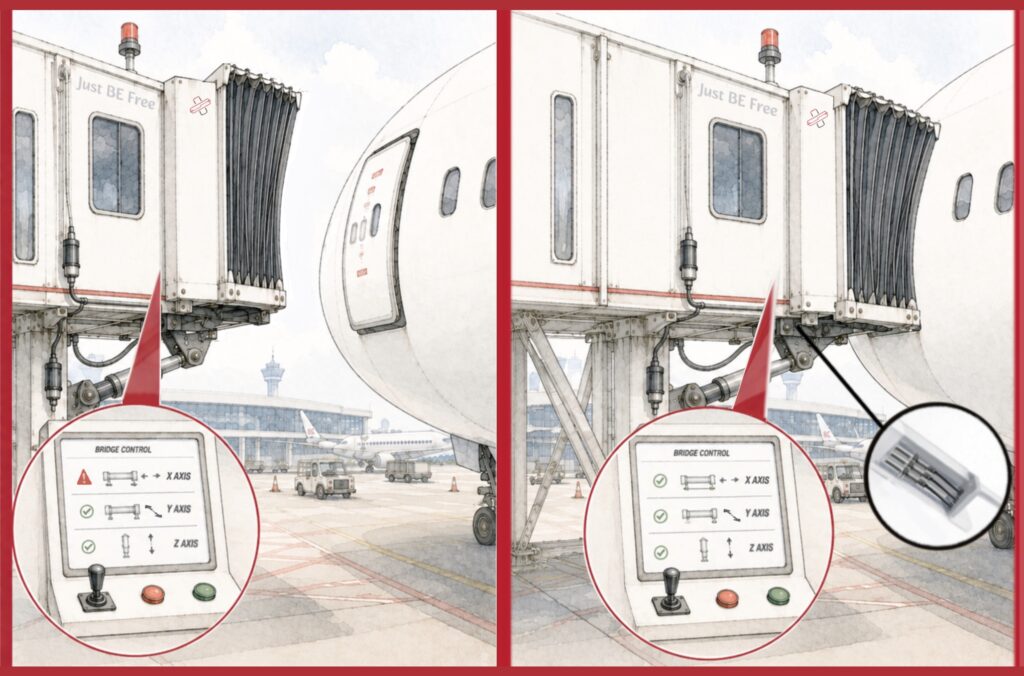
Accurate monitoring of movement along the X, Y, and Z axes is essential for controlled bridge operation. The X-axis controls bridge extension and retraction, the Y-axis controls transverse alignment with the aircraft, and the Z-axis controls the bridge height to match different aircraft door elevations. Continuous feedback of movement in all three axes allows the control system to regulate motor speed, slow the bridge during final approach, and stop precisely at the docking position. Reed Sensors help in reliable position feedback.
Small permanent ring magnets are mounted on each of the rotating motor shafts or encoder wheels, while a multiple reed sensor are installed on every axis to detect the rotations. Every revolution of the shaft causes the magnet to pass the reed sensor, generating an electrical pulse. By counting these pulses, the controller accurately calculates the distance travelled by the extension drive, elevation mechanism, or rotation system. The controller continuously compares the pulse count with the required position and adjusts motor operation accordingly. During the final docking sequence, the pulse information enables smooth deceleration and highly accurate positioning of the boarding bridge.
🧰 Application Classification
Applications are classified as Position Sensing, Pulse Counting, Electromagnetic or Relay, Temperature Sensing or Magnet Biasing types. This application is classified as follows and the link gives more information on best practices to help select the most suitable AT band and matching magnet.
✅ Recommended Products
The Reed Switches and Sensors used in such applications need to be robust, durable and efficient in meeting a high life expectancy. Our engineers work hard in life testing our products under various conditions, and our intention is to ensure end product durability and life. Although we wouldn’t want to restrict any of our products for use in only certain applications, the recommended products for use in this application are listed below.