

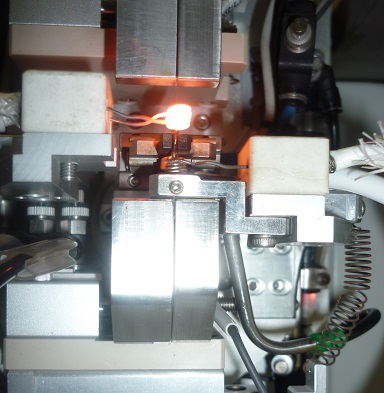
Reed Switch Sealing involves using two sputter coated reed blades inserted into either ends a glass tube. The thermal expansion coefficients of the metal allots and the glass tube need to be similar to ensure there is no stress after the seals are made. Inert gases are mixed within the tube to protect the integrity of the Ruthenium coated blades.
The open ends of the glass tube are sealed at 1000C using special heaters. Various heat sources like wire-wound heaters, band heaters, infrared lamps, or lasers can be used for sealing, but the wound heaters provide the best seal shape. This also ensures is withstands subsequent lead formation better.
The reed blades are placed at each end of the glass tube and brought into contact overlap with a fixed distance between them. This gap is normally less than 5 microns for miniature reed switches. The gap between the blades is measured, and one blade is adjusted slightly based on magnetic sensitivity calculations. Gas is then introduced, and the heating process seals the glass tube ends hermetically, making the reed switch.
Completed reed switches undergo testing for seal integrity before further inspection is carried out. Attention to detail and adherence to strict procedures are crucial to maintain the quality and reliability of the finished reed switches. Each step in the sealing process contributes to the overall performance and longevity of the reed switches. Quality control measures are implemented to verify the integrity of the seal before the switches advance to subsequent inspection stages.
One final test that is done prior to Tin plating of the leads is to check a batch of reed switches for magnetic remanence. Positive and negative direction voltages are used in sequence to measure the operate AT from both directions. When the annealing is within parameters, these readings will be acceptable with not much difference in the measurements. The finished reed switches are then taken for Tin plating of the leads.