

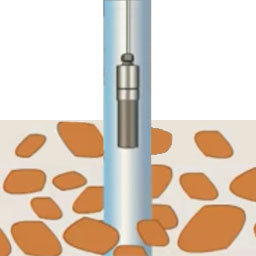
Boring holes in the ground serves various purposes, such as extracting water, gases, or conducting geological and environmental assessments. Throughout this process, it’s essential to interconnect pipes to prevent cave-ins. Once the boring is complete, periodic assessments, like measuring water levels, are necessary by using liquid detection probes.
Reed switches play a crucial role in this context. Traditional reed switches in float switches, with lengthy cables, struggle in such boreholes because the external float can be triggered by the bore walls.
To address this issue, standard float switches can be enhanced by fitting them with a perforated sheet around the entire float assembly. This modification ensures that when inserted into the bore, the physical walls don’t displace the float, preventing incorrect activation of the reed switch. The perforated sheet allows liquid to seep in, activating the float during liquid detection runs. This entire assembly can function as a liquid detection probe and be lowered into deep, narrow bores with the aid of the lead wire.
In summary, borehole drilling serves diverse purposes, demanding reliable equipment to maintain safety and accuracy. Reed switches, especially when integrated into float switches with perforated sheet enhancements function as a liquid detection probe, providing a dependable solution for accurately assessing borehole conditions.
✅ Recommended Products
The Reed Switches and Sensors used in such applications need to be robust, durable and efficient in meeting a high life expectancy. Our engineers work hard in life testing our products under various conditions, and our intention is to ensure end product durability and life. Although we wouldn’t want to restrict any of our products for use in only certain applications, the recommended products for use in this application are listed below.